

Essay
Five Essential Lessons from Néstor Almendros
Encountering the master cinematographer through his own words.
Nothing but Light: Lensed by Néstor Almendros is currently screening at Metrograph.
Share:
“Though people think a cinematographer has to take care of lighting first and foremost, I believe the framing is just as important. By means of the camera’s viewfinder, the outside world goes through a process of selection and organization. Things become pertinent.”
—Néstor Almendros, A Man with a Camera
Whether he was chasing eternal verdant greens and bare legs (Rohmer, Eustache), clowning around with talking apes in cages (Schroeder), or suffocating inside a creepy, dank hall-of-the-dead (Truffaut), Néstor Almendros knew the value of a precise narrative frame. Depending on what crowd you hang with, the very word “narrative” can be deemed pornographic (“No plot for me—I do pure cinema!”) or needed like an adult diaper (“It’s been weeks and I don’t think we’ve hit the proper inciting incident,” I once overheard two screenwriters say as they tussled publicly over their treatment). But for the Barcelona-born cinematographer—who famously worked wonders enhancing stories with natural light, whether following cockfighters (Hellman) or dying mums (Pialat)—the parameters of the film field needed to be ruthlessly defined.
This was the only way the accidental could, he believed, flourish as a sign of surprising life within a work of art. To flirt with and tumble out of a willful naïveté, to bend rules, to refine and start a new tradition of his own that prized an eccentrically composed realism: this was the Almendros path. Beyond the obvious fanatical chase for the waning and dancing rays of the Sun, his “touch” was not so concrete a principle as Lubitsch’s; nevertheless, one recognizes the hushed Almendros patience and intelligence when faced with it. His best work was with John Ford-esque directors—Truffaut and Rohmer above all—who were able to cut within the camera, preserving precious film stock while adhering to the Bazinian principle of decoupage before montage, of cultivating a philosophy before rolling camera to see if reality matches up with one’s theory. Almendros adhered to a strict frame while investing it with a Renoirian openness and ripple, as chance moments and happy accidents proliferated at the edges of the image. And what more scientific way to examine the Almendros frame than to return to the self-made record of his life: his autobiography, A Man with a Camera, published in 1980, 12 years before his death?

The Green Room (1978)
In this invaluable book, Almendros left us with an impeccable literary record of his achievements, detailing the many, many films on which he worked. His list of credits is staggering. Of the works screening in the Metrograph series, highlights include Truffaut’s excruciatingly moving The Green Room (1978), Hellman’s and Roger Corman’s stoic study of rooster fighting, Cockfighter (1974), and Eustache’s unforgettable, disturbing self-portrait of a boy artist in the making, My Little Loves (1974), not to mention Almendros’s big US masterpiece, Terrence Malick’s Days of Heaven (1978), for which Almendros won the Oscar for Best Cinematography. Beyond the Metrograph program, though, are even more of the fearless films Almendros was realizing in the 1960s and 1970s such as Rohmer’s eccentric adaptation of a Kleist novella (1976’s The Marquise of O…), Truffaut at his most mordantly romantic (1971’s Two English Girls), and Marguerite Duras’s funniest low-key drama (1977’s Entire Days in the Trees). (In the final few years of his career—cut tragically short due to his death from AIDS-related complications—Almendros would go on to further develop what he had dubbed his “classicist scruples,” flirting with post–New Hollywood white elephantism, viz. his final works for Robert Benton, Nora Ephron, and Mike Nichols, which, by contrast, are necessarily conventional.)
A Man with a Camera opens with Almendros, born October 30, 1930, recounting the circumstances—political and otherwise—that led him to becoming a cinematographer. He came “from a Loyalist family,” and his father left Spain when Franco’s fascists took control in 1939. Looking back on the first nine years of his life, Almendros recounts the “escapist films” that helped take his mind off the impending fascist takeover of the country; he was particularly taken with Frank Capra’s Lost Horizon (1937). What’s interesting in these accounts is seeing the two sides of Almendros—the leftist political dissident, and the strident aesthete—equally emerge fully-formed. From his early years in Spain, and his subsequent periods based in Cuba, the United States, and France, Almendros understood how intertwined politics and aesthetics were, and how to skillfully combine the two. “From that time,” he writes, “I have never attacked the so-called escapist cinema as some people do, because I think it helps many poor souls get through their lives, as it helped me in those precarious days.”
When he came to Cuba, it was with his same left-humanist vision that he absorbed the cinemas of Latin America, Europe, and the USs. He recounts an early attempt at filmmaking, trying to realize, with Cuban friends, an adaptation of Chekhov’s “The Pharmacist” as an 8mm Gone with the Wind (1939). “Adolescent illusions of grandeur,” he says, dismissing the effort. “Instead of telling simple stories about the life around us, the daily reality of a tropical island like Cuba, we were grasping at a distant, pale reflection of the artistic world of Europe. We were intellectually colonized. Luckily, we eventually realized this was a fruitless struggle.”
Yet intellectual colonization was the exact phrase that Almendros would go on to use to critique the type of cinema favored by ICAIC (the Instituto Cubano del Arte e Industria Cinematográficos), Cuba’s innovative state-funded film school. ICAIC was founded in the wake of Fidel Castro’s successful toppling of the capitalist dictator Fulgencio Batista in 1959, and was set up as the image-creating filmmaking wing of Castro’s revolution against the inhumanities of imperialism, global capitalism, and US-first colonialism. With this, Almendros saw an opportunity for himself. By this point, he had studied the basics of filmmaking in Rome and New York. But when Castro took over, as Almendros writes, “the revolution attracted me irresistibly,” and was eager to extend his developing knack for cinema in the service of a galvanizing mass movement unlike anything the postwar globe had seen up to that point.
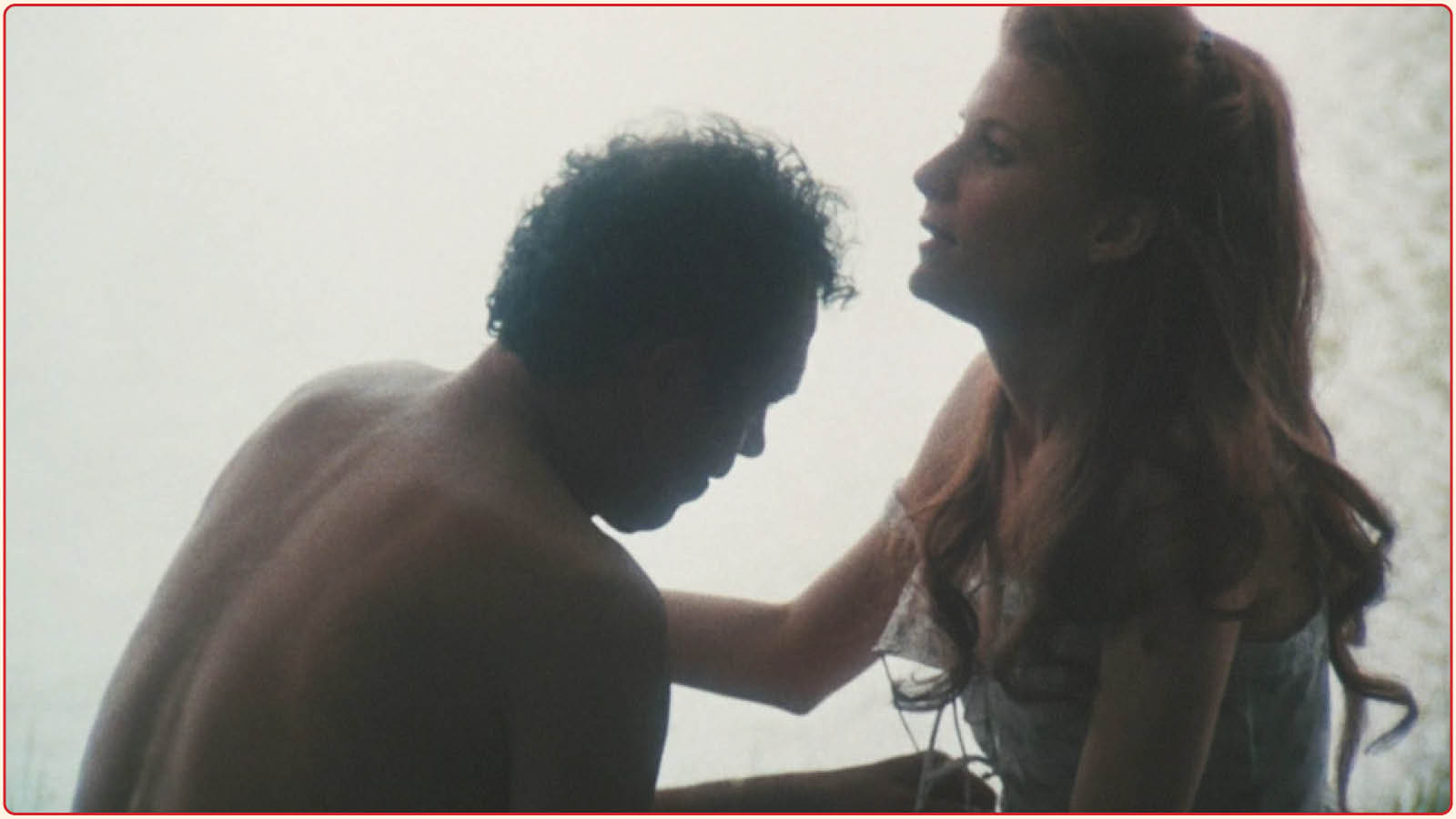
Cockfighter (1974)
Upon arriving in Cuba, Almendros shot a few films. But he soon realized how dire the filmmaking situation was, and how much more dire it would get. He could only function as a cameraman under directors who were cranking out short propaganda films that “had very limited interest” for him. The situation worsened in 1961, after the failed US invasion of Cuba at the Bay of Pigs. A now-paranoid Castro, narrowly escaping assassination, nationalized the film industry, placing it under the direction of one man, Alfredo Guevara Valdés. As Almendros observes, “I realized that I was not working for the people, as was claimed, but for a state monopoly, and that the current authorities acted like any capitalist producer, forcing us to humor them in just the same way or worse, the only difference being their hypocritical use of social pretexts.”
Roused to action, Almendros became more forceful in his critique: “I said that they were trying to imitate Hollywood and that the lighting was false. Paradoxically, they began calling me a counterrevolutionary.” An old Italian cinematographer was imported from Europe to shoot ICAIC’s first feature-length films, further infuriating Almendros, who took the words of the revolution at face value: a cinema of the people, for the people.
Feeling creatively stymied, financially precarious, and at wits’ end, a desperate Almendros pulled off one last trick: he became a freelance film critic. As soon as he got a role contributing to the nationalized weekly Bohemia, he spoke up for one of the most controversial films of the period, Orlando Jiménez Leal and Sabá Cabrera’s P.M. (1961), a middling, Poetic-with-a-capital-“P” documentary short about what a bevy of bourgeois and working-class Cubans were doing on the night of the Bay of Pigs: smoking, drinking, shaking ass. Valdés was furious at any praise. Well, Néstor liked it—pitié! Castro himself then stepped in to attack the film and any “intellectual” who defended it, ending with his famous dictum: Dentro de la Revolución, todo; contra la Revolución, nada! or: “Within the Revolution, everything; against the Revolution, nothing!”
Almendros, still developing his artistic voice, felt caught between the proverbial rock and a hard place. Neither communism nor imperialist capitalism worked for him; both, he believed, could only result in art and expression of utmost mediocrity. But as he relates it, the death knell for his career in Cuba came in the form of a top 10 list, tallying the best films of 1959.
As usual, the Association of Cinematographic critics met at year end to choose the 10 best films of the year. First place had to go to the Russian Ballad of a Soldier by Chukhrai; I voted for Truffaut’s The 400 Blows. Mine was the only dissenting voice. A short while later I was fired from Bohemia. Little did I think then, in 1961, that a few years later I would be working with the French director whom I so admired! This has been one of the great surprises and rewards of my career. Eventually I decided to leave Cuba because I realized something worse would happen to me if I stayed…. A third exile seemed my only choice.
Almendros, poor and confused, had two not very tantalizing options: move to the US or France. He could not personally stand the gusanos who left in droves for Florida—“I had had enough of political exiles”—so he took the next plane to France, largely because of its status as the birthplace of film. In his own words, “I felt that what they were doing—the cinematheque heritage, the practice of film criticism, and the adoption of techniques that went counter to those then considered professional—had some connection with what I had done in Cuba, and it occurred to me that French cinema might have a place for me.” Amazingly, this “crazy idea…worked.” Five years later, Almendros would be hired to finish Rohmer’s Hitchcockian comedy sketch Six in Paris (1964), thus kickstarting Almendros’s second phase.
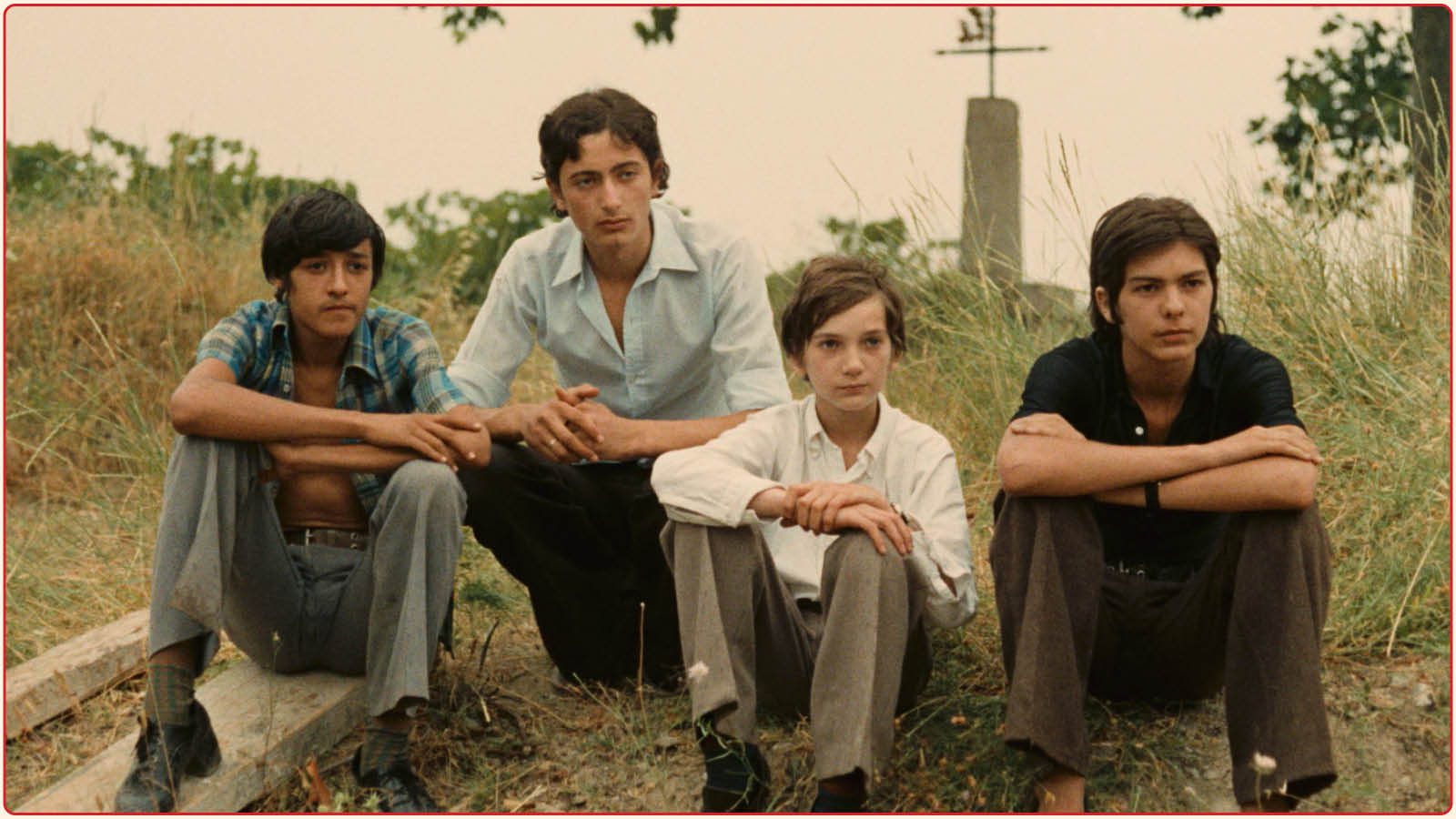
My Little Loves (1974)
A Man with a Camera proceeds pretty straightforwardly from here. I can’t begin to describe the riches to be unearthed in reading about how Almendros, with each new project, never wanted to repeat the achievements of his previous film. He was always searching, always angling for a new light, a new way to refine his frame. I’ll cap off with a top 10—well, top five—of my own, of essential lessons from the master of the frame:
See as many films shot by Almendros as possible:Many members of my profession think they can make films without taking the trouble to see what other people do. This has always astonished me: how can one do something new without any idea of what has been done before? I am convinced that one learns most from seeing the classics in film clubs and cinémathèques. To learn lighting it is also useful to visit art museums, examine reproductions of famous paintings, and in general to develop an appreciation of the arts.
Don’t be like the Americans. Don’t waste time on silly coverage. Know your decoupage. Be thrifty. Or else the result will look like it was edited by AI:Like Truffaut or Malick, [Wim] Wenders does not edit to make filming easier, multiplying the angles in order to decide later on what can be done at the Moviola. Ideally, each shot must be conceived in a certain way. The film will derive its form from this concept. If there is no concept to begin with, there is no style. In art I believe in discipline. After my recent experiences with American filmmaking, I can state categorically that American directors shoot far too many hundreds of thousands of feet of negatives… Films made out of a superabundance of material tend to resemble each other, because they have all been shot according to the same methods. A computer could make this sort of film equally well. It could easily decide which positions and angles of the camera are needed to cover a certain scene.
When in doubt, emulate Rohmer:Rohmer’s obsession with economy has something to do with his personality and also with his conception of film. It is almost an ecological question: he wants to save energy, to avoid waste. And he always tries to simplify his camera movements… To choose the angle for a take, his procedure is as follows: before the shooting everyone goes to the place where the scene is to be filmed, and the camera setups are chosen. And yet these decisions are rarely respected. Later on, when things have gotten underway, Rohmer tries out new camera positions and discusses them with me before making the final choice. In order words, he actually works like the Americans, who shoot a scene from many angles, except that he does it mentally, without film. What the Americans decide on the Moviola, Rohmer has already decided while filming, having mentally exhausted all other possibilities.
The plan-séquence is your friend:
The Green Room was conceived as a succession of plans-séquence. The term “master shot” is used in English for what in French is plan-séquence, but the two expressions mean different things, because a master shot implies that there will be supplementary shots of the same scene (often close-ups), and that these will be inserted later on during the editing. The fact that there is no American expression for a plan-séquence is evidence of a basic difference in concept. In Truffaut’s plan-séquence, nothing can be inserted because it is sufficient unto itself.
The idea that we have advanced since the silent cinema is an illusion. (What was it Shiguehiko Hasumi said? “All movies are but variants on the silent film”?)The film industry is said to have made great technological progress. I would contest this claim… [Malick’s and my] model was the photography of the silent films (Griffith, Chaplin, etc.), which often used natural light. And in the nighttime interiors we often used just a single light. Thus, Days of Heaven was a homage to the creators of the silent films, whom I admire for their blessed simplicity and their lack of refinement. From the ’30s on, the cinema had become much too sophisticated.

Days of Heaven (1978)
Share:
Recommended
- Green Snake
 On Tsui Hark’s subversive reimagining of an immortal Chinese folk tale, starring Maggie Cheung as a serpent demon.
 - Travel Companions: Bahram Beyzaie & Amir Naderi
 On two defining Iranian filmmakers, and two of their most enduring works.
 - A New Love in Tokyo
 On the pulse of pleasure in Banmei Takahashi’s effervescent Pink drama.